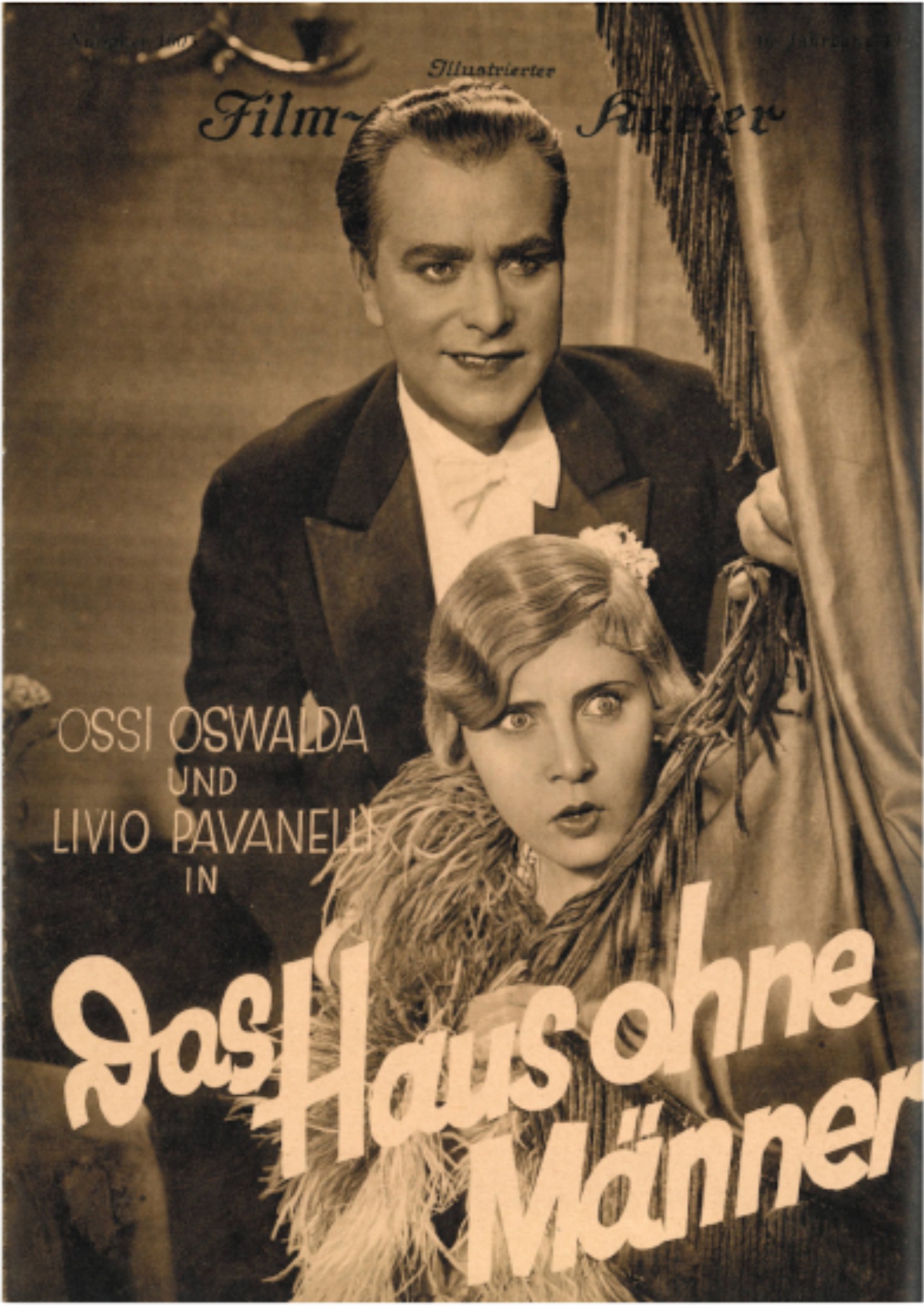
Das Haus ohne Männer is a 1928 German silent comedy directed by Rolf Randolf and starring Ossi Oswalda. A contemporary Illustrierter Film-Kurier, No. 1003, preserves both a detailed synopsis and a particularly important credit for Max Ehrlich: "Titel: Max Ehrlich." Filmportal independently records Ehrlich's contribution as Inserts. In modern English terminology, he wrote the film's intertitles — the dialogue and narrative cards seen by the audience between photographed scenes.
The distinction is significant. Curt J. Braun wrote the screenplay, while Ehrlich was separately credited for the wording presented on screen. The surviving programme does not reproduce the individual intertitle cards, so Ehrlich's exact lines cannot be reconstructed from it; nevertheless, the contemporary credit documents a distinct writing contribution to the finished silent film.
The story centres on four independent working women — Eva, Elisa, Tamara and Marianne — who share a house from which men are excluded. Their leader is Eva, played by Ossi Oswalda. Into this deliberately male-free household comes Friedel, who has very different ideas about love and is happily engaged to Lothar until she is suspected of a 500-mark shortage and, while seeking his help, sees him with another woman. Misunderstanding the situation, she flees to the House Without Men.
Lothar has in fact been trying to protect Friedel. He takes 500 marks from his own bank to replace her missing money, hoping to restore it from his salary before the next audit. Unable to reach Friedel, he is treated by her new friends as the faithless fiancé from whom she must be protected.
Eva decides to confront Lothar, but having never seen him she mistakes his best friend Ralf for him. The supposed villain proves unexpectedly charming, and Eva gradually falls in love with the man she believes to be Friedel's fiancé. Meanwhile the real Lothar makes his way into the house at night, reaches Friedel and clears up their misunderstanding.
Ralf then carries Eva off on a motorboat for two days. While they are away, the bank audit takes place earlier than expected; the women combine their resources and replace Lothar's shortage. Eva returns prepared to confess the scandalous truth to Friedel — only to be introduced to the real Lothar. Ralf finally reveals his own identity, both couples are united, and the programme closes with the joke that the House Without Men is now to be offered for rent elsewhere.
Filmportal gives 4 December 1928 as the premiere date. A Dresden newspaper advertisement dated 29 November 1928 already announced a local Erstaufführung of the film, so the precise regional release chronology may warrant further research.