|
This final production by the Westerbork Theater Group premieres in June 1944, but there will be no further performance.
The Allied landings in Normandy have already taken place. Time is running out for Germany—but tragically also for most of the remaining members of the theater troupe and for thousands of other Westerbork prisoners.
Despite censorship, reports of mass murder in the East are filtering into the camp. Whether these reports directly influence the revue cannot be established. Nevertheless, its title, its grotesque humor and its repeated imagery of madness unmistakably reflect a world in which ordinary reason and morality have collapsed.
Max Ehrlich gives the production the title Total verrückt—Totally Crazy. Words such as “crazy,” “insane” and “stupid” recur throughout the program.
One scene presents the invention of the guillotine as “Ten Minutes of Inventive Folly.” Another depicts a general outbreak of insanity; in still another, women turn into hyenas.
During the finale of the first half, the musicians stage a symbolic revolt by refusing to remain seated in the orchestra pit.
The gesture may have been more than comic stage business. It could be understood as a symbolic demonstration of collective noncompliance and as a disguised appeal to the prisoner audience to preserve solidarity and resist inwardly, even when open resistance was impossible. By refusing to remain in the place assigned to them, the musicians transform the revue’s metaphor of madness into an act of refusal.
After the intermission, the program announces:
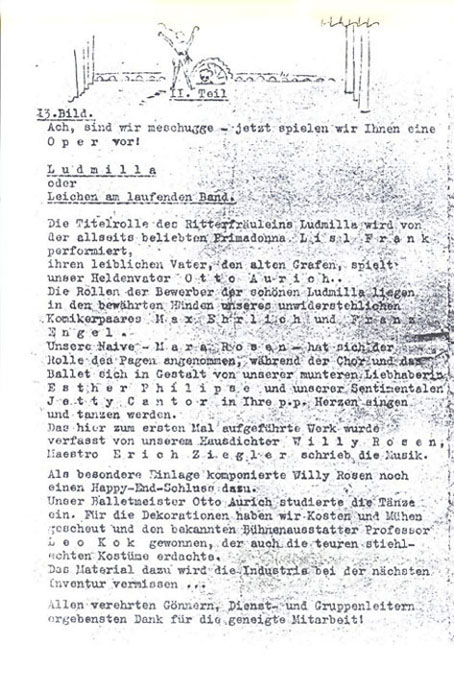
“Oh! Are we crazy—now we are going to perform an opera for you!”
The opera parody is entitled Ludmilla oder Leichen am laufenden Band—Ludmilla, or Corpses on the Conveyor Belt. Amid this grotesque procession of madness and death comes a solemn plea for “a happy ending.”
No happy ending will come for the overwhelming majority of those deported through Westerbork.
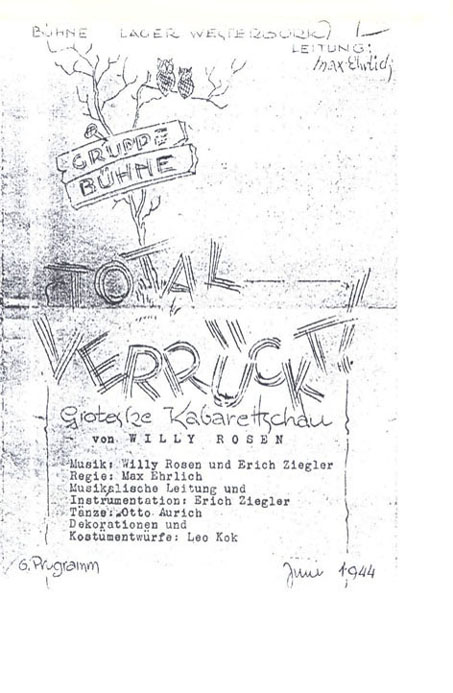
The program cover reinforces the production’s message. “TOTAL” appears scattered and partly collapsed, as though the word itself has fallen apart. “VERRÜCKT” is fractured, irregular and dramatically enlarged, with its letters leaning in different directions. The sign “GRUPPE BÜHNE” hangs upon a bare, almost lifeless tree, watched over by two owls, while the forms below resemble debris, broken stage scenery or a landscape thrown into disorder.
The subtitle explicitly describes the production as a Groteske Kabarettschau—a grotesque cabaret show. Unlike the earlier Westerbork revues, this is not presented as cheerful entertainment. Its visual world is one in which language, order and normal proportions have broken down. The program itself repeatedly invokes madness, stupidity, megalomania and grotesque inversion.
The title could still be defended before the camp authorities as conventional cabaret exaggeration: the comedians are crazy, the characters are crazy and the theatrical world is crazy. Yet to prisoners living amid deportations, it could convey a far more dangerous meaning: the entire moral and political reality surrounding them had become deranged.
That ambiguity was essential. Direct denunciation would have been impossible. Grotesque comedy allowed the artists to communicate something recognizable without stating it openly.
Madness becomes a protective metaphor for persecution, arbitrary power, deportation and the inversion of all ordinary morality. The cover and performance should therefore not be understood as open resistance, but as something more carefully disguised—a camouflaged judgment and, possibly, a coded appeal to refuse submission.
|
|
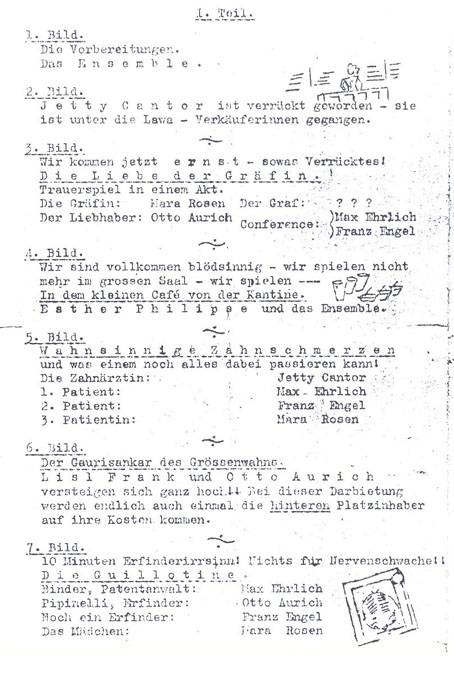
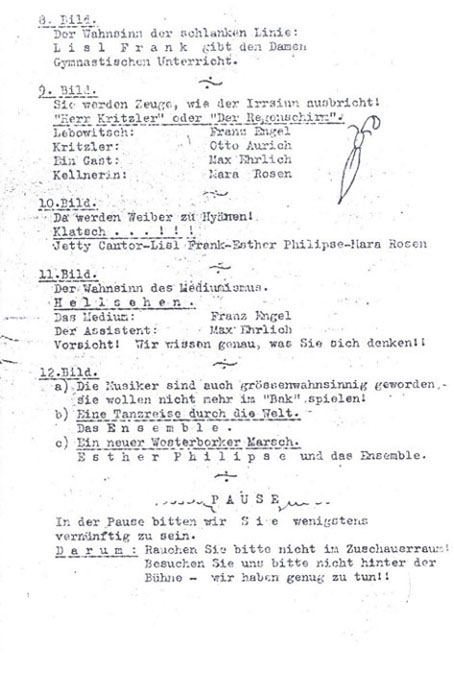
The program lists 13 scenes:
| 1. |
The
Preparations (The full cast) |
|
Die Vorbereitungen (Das Ensemble) |
|
|
| 2. |
Jetty
Cantor has Gone Crazy - She has Joined the Lava Saleswomen. |
|
Jetty Cantor ist
verrückt geworden - sie ist unter die Lawa Verkäuferinnen gegangen. |
|
|
| 3. |
[We are
getting Serious Now - What Insanity!] The Loves of the
Countess. [Tragedy in One Act] (Mara Rosen, Otto Aurich, Max
Ehrlich, Franz Engel) |
|
[Wir kommen jetzt ernst
- sowas Verrücktes!] Die Liebe der Gräfin [Trauerspiel in
einem Akt] (Mara Rosen,
Otto Aurich, Max Ehrlich, Franz Engel) |
|
|
| 4. |
[We are
Completely Stupid - We are No Longer Playing in the Big Hall - We're
Playing--- ] In the Small Café of the Canteen. (Esther Philipse and
The full cast) |
|
[Wir sind vollkommen
blödsinnig - wir spielen nicht mehr im grossen Saal - wir spielen
---] In dem kleinen Café von der Kantine.
(Esther Philipse and
The full cast) |
|
|
| 5. |
An Insane
Toothache [And Everything Else that can Happen to you with this!] (Jetty
Cantor, Max Ehrlich, Franz Engel, Mara Rosen) |
|
Wahnsinnige
Zahnschmerzen [und was einem noch alles dabei passieren kann! (Jetty
Cantor, Max Ehrlich, Franz Engel, Mara Rosen) |
|
|
| 6. |
The
Gaurisankar (ed. high peak in Himalayas,
near Everest) of Megalomania [Lisl Frank and Otto Aurich Sell
Themselves Very Well. In this Presentation, the Audience in
the Back Rows Will Finally, for Once, also get their Money's Worth.] |
|
Der Gaurisankar des
Grössenwahne [Lisl Frank und Otto Aurich versteigen sich ganz hoch.
Bei dieser Darbietung werden endlich auch einmal die hinteren
Platzinhaber auf ihre Kosten kommen.] |
|
|
| 7. |
[10
Minutes of Inventive Folly! Not for the Faint of Heart!!] The
Guillotine (Max Ehrlich, Otto Aurich, Franz Engel, Mara Rosen) |
|
[10 Minuten Erfinderirrsinn! Nichts für Nervenschwache!!] Die
Guillotine (Max
Ehrlich, Otto Aurich, Franz Engel, Mara Rosen) |
|
|
| 8. |
The
Insanity of Staying Thin: Lisl Frank Gives the Ladies Gymnastic
Lessons. |
|
Der Wahnsinn der
schlanken Linie: Lisl Frank gibt den Damen Gymnastischen Unterricht. |
|
|
| 9. |
[You'll
Witness How Insanity Breaks Out!] "Mr. Kritzler" or "The Umbrella" (Franz
Engel, Otto Aurich, Max Ehrlich, Mara Rosen) |
|
Sie werden Zeuge, wie der Irrsinn ausbricht!] "Herr Kritzler" oder
"Der Regenschirm".(Franz
Engel, Otto Aurich, Max Ehrlich, Mara Rosen) |
|
|
| 10. |
[There,
Women are Turning into Hyenas!] Gossip...!!! (Jetty
Cantor, Lisl Frank, Esther Philipse, Mara Rosen) |
|
[Da werden weiber zu
Hyänen!] Klatsch...!!! (Jetty
Cantor, Lisl Frank, Esther Philipse, Mara Rosen) |
|
|
| 11. |
[The
Insanity of Visiting a Medium.] Clairvoyance. (the medium: Franz
Engel, the assistant: Max Ehrlich) [Careful! We Know Exactly What
You're Thinking!!] |
|
[Der Wahnsinn des
Mediumismus.] Hellsehen. (Das Medium: Franz Engel, Der Assistant:
Max Ehrlich) [Vorsicht! Wir wissen genau, was Sie sich denken!!] |
|
|
| 12. |
a) The
Musicians have also gone
Megalomaniac - They No Longer
Want to Play in the "Pit"!
b) A Dance Tour of the World. (The
full cast)
c) A New Westerbork March.
(Esther Philipse and The full cast) |
|
a) Die Musiker sind
auch grösswahn-
sinnig geworden - sie wollen nicht
mehr im "Bak" spielen!
b) Eine Tanzreise durch die Welt.
(Das Ensemble)
c) Ein neuer Westerbork Marsch.
(Esther Philipse und Das
Ensemble) |
|
|
|
(INTERMISSION) |
|
|
| 13. |
[Oh,
are We Crazy - Now We're Performing an Opera!] Ludmilla [or] Corpses
Without End. (The star role of knight's damsel is performed by the
universally beloved prim Donna Lisl Frank; her earthly
father, the old count, is played by our paternal hero Otto Aurich;
the roles of beautiful Ludmilla's aspirants are placed in the valued
hands of our irresistible comedy duo Max Ehrlich and Franz Engel;
our ingénue Mara Rosen has assumed the role of page, while the
chorus and dancers, embodied by our alert lover Esther Philipse and
our sentimental Jetty Cantor, in their place,
will sing and dance from their hearts; this
piece, presented here for the first time, was created by our house
poet Willy Rosen, while Maestro Ziegler
has written the music; as a special insertion, Willy Rosen has also
composed a happy ending to the piece; our choreographer Otto Aurich
integrated the dance numbers; for the scenery, we spared cost and
effort by using the well-known stage designer Professor Leo Kok, who
also created the expensive period-accurate
costumes for which the material will be found missing at the next
camp industry inventory. With thanks to all honored donators,
service heads and group leaders for bending backwards in their
cooperation.) |
|
[Ach, sind wir
meschugge - jetzt spielen wir Ihneneine Oper vor!] Ludmilla [oder]
Leichen am laufenden Band. (Die Tittelrolle des Ritterfräuleins
Ludmilla wird von der allseits beliebten Primadonna Lisl Frank
performiert; ihren leiblichen Vater, den alten Grafen, spielt unser
Heldenvater Otto Aurich; die Rolle der Bewerberder schönen Ludmilla
liegen in den bewährten Händen unseres unwiederstehlichen
Komikerpaares Max Ehrlich und Franz Engel; unsere Naive - Mara Rosen
- hat sich der Rolle des Pagen angenommen, während der Chor und das
Ballet sich in Gestalt von unserer munteren Liebhaberin Esther
Philipse und unserer Sentimentalen Jetty Cantor in Ihre p.p. Herzen singen und tanzen werden; das hier zum ersten Mal aufgeführte Werk
wurde verfasst von unserem Hausdichter Willy Rosen, Maestro Erich
Ziegler schrieb die Musik; als besondere Einlage komponierte Willy
Rosen noch einen Happy-End-Schluss dazu; Unser Balletmeisert Otto
Aurich studierte die Tämze ein; für die Dekorationen haben wir
Kosten und Mühen gescheut und den bekannten Bühnenausstatter
Professor Leo Kok gewonnen, der auch die stiehl-echten Kostüme
erdachte - das Material dazu wird die Industrie bei der nächsten
Inventur vermissen... Allen verehrten Gönnern, Dienst- und
Gruppenleitern ergebensten Dank für die geneigte Mitarbeit!) |
|
|
|
|
The performers named in the
program are:
| - |
Jetty Cantor |
| - |
Esther Philipse |
| - |
Mara Rosen |
| - |
Otto Aurich |
| - |
Max Ehrlich |
| - |
Franz Engel |
| - |
Willy Rosen |
| - |
Erich Ziegler |
Also named:
Further Meanings and Context
The Bare Tree and the Owls
The bare tree suggests desolation, sterility, suspended life or a world from which vitality has been stripped away.
Yet the sign of the theater group remains attached to it. Symbolically, the stage survives even when the surrounding world has been laid bare.
The meaning of the two owls is less certain. They might suggest watchfulness in darkness, intelligence, artistic perception, nocturnal life, foreboding or death.
We cannot know exactly what associations were intended. Their position above the theater sign nevertheless makes them resemble silent witnesses—creatures able to see in darkness when others cannot.
Professional Identity as a Form of Resistance
The lower half of the cover is strikingly formal. It carefully records:
Willy Rosen as author;
Willy Rosen and Erich Ziegler as composers;
Max Ehrlich as director;
Erich Ziegler as musical director and orchestrator;
Otto Aurich responsible for dance;
Leo Kok responsible for scenery and costume designs.
This is not presented as casual camp entertainment. It is a complete professional theatrical credit list.
That insistence upon names, artistic disciplines and individual responsibility is significant. The Nazi system sought to reduce people to prisoners, labor categories and transport numbers.
The program instead identifies them as writers, composers, directors, choreographers and designers. It preserves the civilized structure of a theater company within an institution designed to deny their individuality.
The heading “Bühne Lager Westerbork—Leitung Max Ehrlich” is therefore more than administrative information. It asserts that Max Ehrlich still leads a stage, Willy Rosen still writes, Erich Ziegler still composes, Otto Aurich still choreographs and Leo Kok still designs.
Their professional identities endure, even under conditions intended to destroy them.
Survival and Coercion
The circumstances surrounding the production cannot be reduced to a simple story of heroic resistance.
The theater existed within a system of coercion. Performances provided entertainment for fellow prisoners, but they also served the camp administration and contributed to the appearance of normality that the authorities wished to maintain.
At the same time, membership in the theater group could offer temporary protection from deportation.
The performers were therefore simultaneously:
creating for their fellow prisoners;
entertaining the camp administration;
attempting to prolong their own lives;
maintaining their professional identities;
and participating unwillingly in the camp’s façade of normality.
Art, survival, resistance and exploitation existed together.
The grotesque character of Total verrückt may reflect an awareness of that contradiction. The artists were producing polished entertainment in a place from which men, women and children were being deported to their deaths.
They were not merely escaping reality. They were transforming an unbearable reality into theatrical form.
Overall Reading
The cover and program appear to communicate something close to this:
The world has become completely mad. We know it. Our audience knows it. We cannot say so openly, but we can embody that madness onstage—and we will continue to practise our art with intelligence, precision and dignity.
Total verrückt combines despair with playfulness, fear with professional pride, and concealment with disclosure.
The artists leave enough ambiguity to protect themselves, while making the underlying meaning recognizable to those who share their circumstances.
Their theater becomes both a means of survival and a final assertion of human and artistic identity.
|
|