Revierkrank - In Sickbay is a 1932 German military-themed two-reeler. Günter Knorr’s Deutscher Kurzspielfilm 1929–1940 preserves the film’s concise plot: two recruits are both in love with the Feldwebel’s daughter (the sergeant’s daughter) and try to discredit one another, but in the end the Unteroffizier (corporal) wins the girl’s heart. The surviving record therefore identifies the film as a barracks romantic farce rather than merely a generically titled military comedy.
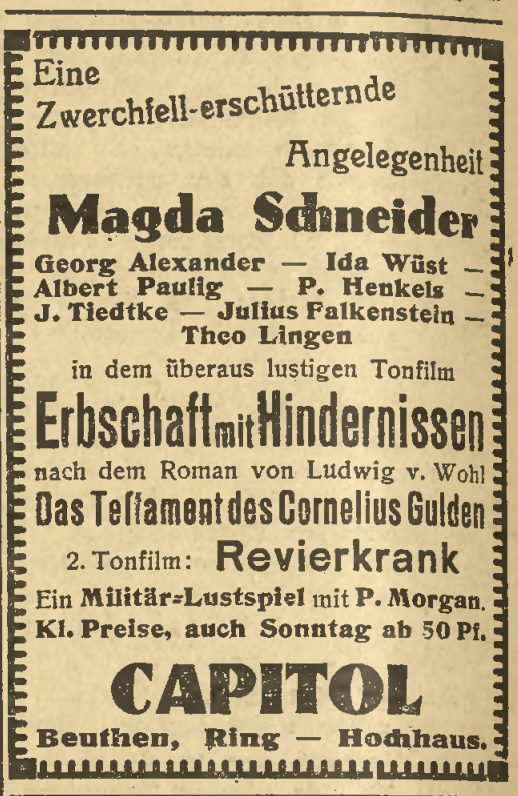
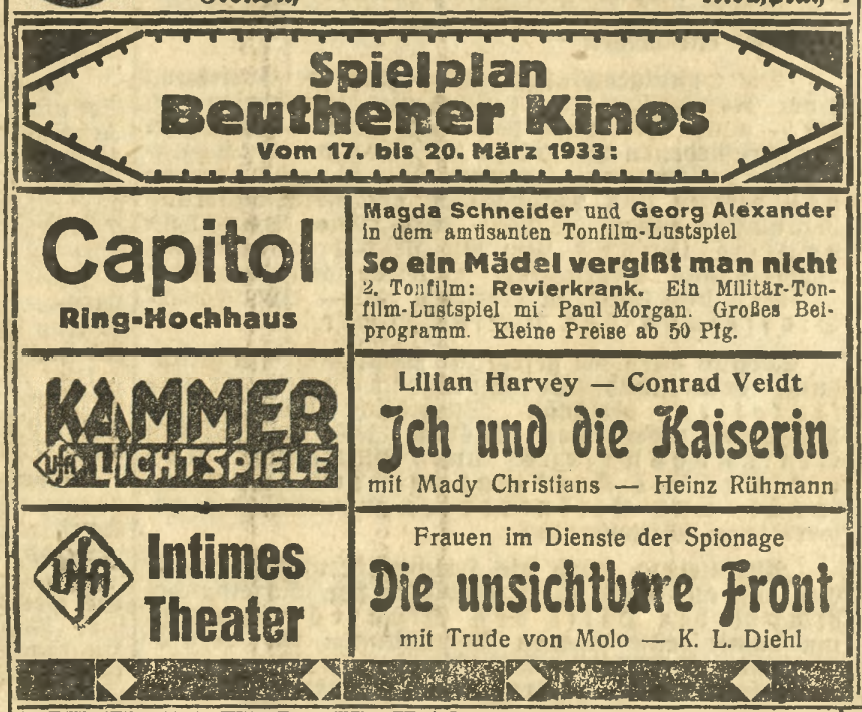
The film’s commercial screenings are documented by at least two separate Capitol cinema advertisements from Beuthen in March 1933. In each case it accompanied a different main feature-film, yet both explicitly billed Revierkrank as a military comedy with Paul Morgan. Those contemporary notices establish Morgan as a member of the cast; the shorter cast listings reproduced by Filmportal and Knorr are simply incomplete.
The title itself is German military language: revierkrank describes a soldier confined to or being treated in the barracks sick quarters.
Notes on the cast: “Fay” or “Faye Wall,” encountered in some database searches, is not an additional performer but an alternative name used by Fee Malten. The available biographical filmography for Carl Heinz Klubertanz also makes Revierkrank appear to have been his final film and his only sound-film appearance.
Archival note: the online Knorr index deliberately omits the Aufführungen (performance) and Verleih (distribution) fields contained in the printed volume, so the web entry is not the complete surviving record. Its notation also does not mention an archival censor-approval card for Revierkrank at either the Bundesarchiv-Filmarchiv or the Deutsches Filminstitut. This does not prove that no card survives today, but it explains why the online record is less detailed than would be expected based on a full censor-approval record.
No screenplay author or precise premiere date has yet been established in the sources consulted, and no online archive record for a surviving print has yet been located. Max Ehrlich is documented here as director; the screenplay cannot yet be attributed to him without further evidence.
Max Ehrlich’s Lux-Film Two-Reel Comedies, 1932–33
These three compact military-themed comedies form a closely spaced Lux-Film cycle directed by Max Ehrlich. Two received censor-approval only six days apart in the autumn of 1932; the third followed less than three months later. Their roughly 23–28 minute running times made them natural added programme attractions: substantial enough to be remembered, but short enough to accompany a feature film.
Presented regularly as supporting films in cinema programmes, such two-reelers could build familiarity of their own. A spectator who had enjoyed one could recognise the type when another appeared on a later bill, giving the supporting programme additional value alongside the main feature. In that sense the format already shows the commercial logic later familiar from recurring radio and television comedy: a compact running time, recognisable situations, and the expectation of another instalment without requiring feature-film length.
For Max Ehrlich the three films are also an unusually coherent glimpse of his brief but active period as a screen director immediately before 1933.